
- Home
- Blog
- Sample Filtration Guide for HPLC, LC-MS, and GC: How to Choose the Right Filter for Your Samples
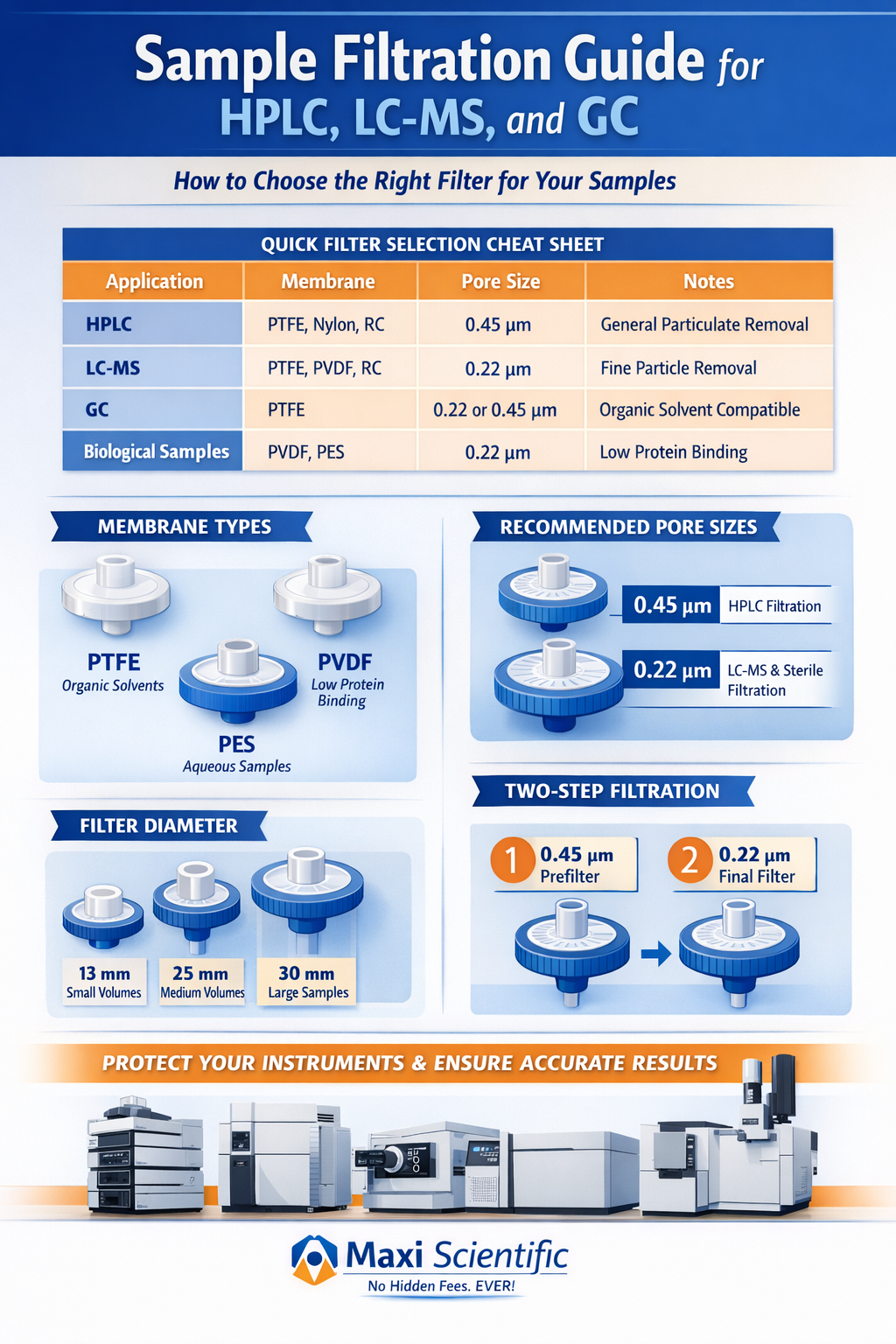
Sample Filtration Guide for HPLC, LC-MS, and GC: How to Choose the Right Filter for Your Samples
Posted by Maxi Scientific on Mar 16th 2026
Filtration is one of the most important — and often overlooked — steps in analytical sample preparation. Whether you're preparing samples for HPLC, LC-MS, or GC analysis, removing particulates before injection protects instruments, improves reproducibility, and prevents costly downtime.
Even small particles can cause serious problems in chromatography systems, including:
-
clogged injector needles
-
blocked guard columns
-
reduced column lifetime
-
increased system pressure
-
poor chromatographic reproducibility
Because of this, proper sample filtration before chromatography is considered standard practice in analytical laboratories.
This guide explains how to choose the right filter for HPLC, LC-MS, and GC samples, including membrane selection, pore sizes, filter diameters, and common filtration mistakes.
Quick Sample Filtration Cheat Sheet
| Application | Recommended Membrane | Typical Pore Size | Notes |
|---|---|---|---|
| HPLC sample prep | PTFE, Nylon, RC | 0.45 µm | General particulate removal |
| LC-MS sample prep | PTFE, PVDF, RC | 0.22 µm | Removes finer particles |
| GC sample prep | PTFE | 0.22 or 0.45 µm | Excellent solvent compatibility |
| Biological samples | PVDF, PES | 0.22 µm | Low protein binding |
| Mixed solvent systems | Regenerated cellulose | 0.22 or 0.45 µm | Compatible with aqueous/organic mixtures |
This table provides a quick reference when selecting filters for chromatography workflows.
Why Filtration Is Critical in Chromatography
Chromatography systems rely on narrow flow paths and precise fluid control. Even very small particles can disrupt system performance.
Particles that enter the system can:
-
block autosampler needles
-
clog guard columns
-
damage analytical columns
-
cause irregular pressure fluctuations
Columns used in HPLC and LC-MS often cost hundreds or even thousands of dollars, making proper filtration a simple and inexpensive way to protect laboratory equipment.
Sample Filtration for HPLC
High-performance liquid chromatography (HPLC) systems require clean samples to maintain stable pressure and consistent chromatographic separation.
Recommended Filters for HPLC
Most laboratories use 0.45 µm syringe filters for routine HPLC sample preparation.
Common membrane choices include:
-
PTFE
-
nylon
-
regenerated cellulose
Why 0.45 µm Filters Are Common in HPLC
A 0.45 µm filter removes most particulate matter while allowing samples to pass through quickly.
Advantages include:
-
fast filtration
-
reduced clogging
-
efficient particulate removal
Many chromatography laboratories use this pore size as the default for HPLC sample preparation.
Sample Filtration for LC-MS
Liquid chromatography–mass spectrometry (LC-MS) systems are often more sensitive than traditional HPLC instruments.
Because of this sensitivity, laboratories frequently choose smaller pore sizes when filtering LC-MS samples.
Recommended Filters for LC-MS
Common choices include:
-
0.22 µm PTFE filters
-
0.22 µm PVDF filters
-
0.22 µm regenerated cellulose filters
Why 0.22 µm Filters Are Used
Smaller pores remove finer particles that could interfere with sensitive mass spectrometry detection.
Using 0.22 µm filtration helps protect both the LC system and the MS interface.
Sample Filtration for GC
Gas chromatography samples often contain organic solvents and volatile compounds.
Because of this, solvent compatibility becomes the most important factor.
Recommended Filters for GC Sample Prep
PTFE syringe filters are typically preferred.
PTFE membranes are chemically resistant and compatible with many organic solvents, including:
-
hexane
-
toluene
-
methanol
-
acetonitrile
-
dichloromethane
Both 0.22 µm and 0.45 µm pore sizes are commonly used depending on sample cleanliness.
Choosing the Right Filter Membrane
Different membrane materials behave differently depending on solvent type and sample composition.
Understanding membrane compatibility is essential when selecting filters for chromatography.
PTFE Membranes
PTFE filters are highly resistant to organic solvents.
Best For
-
HPLC sample prep
-
LC-MS sample prep
-
GC sample prep
-
organic solvent filtration
PTFE membranes are often the default choice for chromatography laboratories.
Nylon Membranes
Nylon membranes are durable and compatible with many aqueous and organic solutions.
Common Applications
-
environmental testing
-
HPLC mobile phase filtration
-
general laboratory filtration
However, nylon membranes may bind proteins, which can cause analyte loss.
PVDF Membranes
PVDF membranes offer very low protein binding, making them ideal for biological samples.
Typical Uses
-
protein solutions
-
enzyme samples
-
biological buffers
-
LC-MS biological analysis
PES Membranes
PES membranes are hydrophilic and designed for aqueous filtration.
Typical Applications
-
biological buffers
-
cell culture media
-
sterile filtration
They are generally not recommended for aggressive organic solvents.
Regenerated Cellulose Membranes
Regenerated cellulose membranes work well with mixed solvent systems.
These membranes are commonly used in LC-MS sample preparation where samples contain both aqueous and organic components.
Choosing the Correct Filter Diameter
Filter diameter affects filtration speed and resistance to clogging.
| Filter Diameter | Typical Sample Volume |
|---|---|
| 13 mm | up to 10 mL |
| 25 mm | 10–100 mL |
| 30 mm | large volumes or particulate-heavy samples |
Larger filters reduce clogging when samples contain suspended solids.
Two-Step Filtration for Difficult Samples
Samples containing large amounts of particulate matter can clog filters quickly.
Many laboratories use a two-step filtration process:
-
Filter with 0.45 µm
-
Follow with 0.22 µm
This removes larger particles first and prevents premature clogging of fine filters.
Common Sample Filtration Mistakes
Even experienced laboratories sometimes encounter filtration problems.
Below are some common issues.
Using the Wrong Membrane
Choosing a membrane incompatible with the solvent can cause membrane degradation or contamination.
For example:
Using PES membranes with aggressive organic solvents may damage the membrane.
Choosing Too Small a Filter
Very fine filters may clog quickly when samples contain significant particulate matter.
Using a larger pore size or pre-filtration step can help.
Using Filters That Bind Analytes
Some membranes bind proteins or other molecules.
For biological samples, low-binding membranes such as PVDF or cellulose acetate are often preferred.
A Simple Workflow for Chromatography Filtration
When selecting a filter for chromatography samples, a simple workflow helps.
Step 1 — Identify solvent compatibility
Organic solvents → PTFE
Aqueous solutions → PES or PVDF
Step 2 — Choose pore size
General filtration → 0.45 µm
Fine filtration → 0.22 µm
Step 3 — Select filter diameter
Small volumes → 13 mm
Larger volumes → 25 mm
Following this approach helps ensure reliable filtration.
Final Thoughts
Proper sample filtration before chromatography improves analytical reliability, protects expensive instrumentation, and reduces system maintenance.
For most laboratories:
-
0.45 µm filters are used for routine HPLC filtration
-
0.22 µm filters are preferred for LC-MS or sterile applications
-
PTFE membranes provide the best compatibility with organic solvents
Selecting the correct filtration strategy helps ensure consistent chromatographic results.
If you ever need help selecting filters for HPLC, LC-MS, or GC applications, feel free to reach out.
At Maxi Scientific, we focus on making lab procurement easier by offering:
-
No hidden fees. EVER!
-
Free ground shipping
-
consistently high product quality
-
fast responses from a real human
If you're comparing syringe filters or sample preparation supplies, we're always happy to help labs find the right option! See our full selction here! https://maxisci.com/chromatography/syringes-and-syringe-filters/