
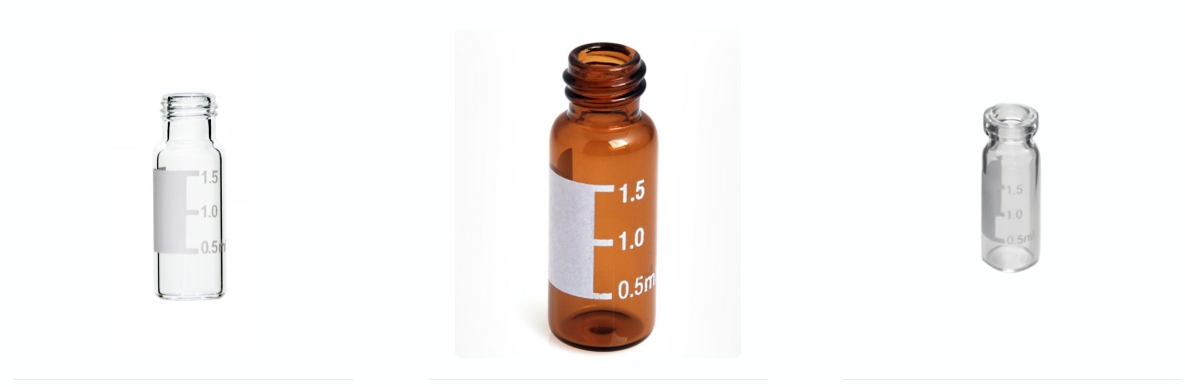
HPLC Vial Compatibility Guide: Autosampler Fit, Dimensions, and Instrument Compatibility
Posted by Maxi Scientific on Mar 16th 2026
High-performance liquid chromatography (HPLC) systems rely on extremely precise sample handling. One of the smallest components in the workflow—the autosampler vial—can have a surprisingly large impact on performance, reliability, and instrument uptime.
Choosing the wrong vial can lead to problems such as:
-
autosampler injection errors
-
needle crashes or misalignment
-
inconsistent injection volumes
-
sample carryover
-
autosampler jams
Because different instrument manufacturers use slightly different tolerances, laboratories often ask the same question:
Which HPLC vials are compatible with my autosampler?
This guide explains HPLC vial compatibility, including vial dimensions, instrument compatibility, insert types, cap styles, and common mistakes that cause autosampler problems.
Quick Reference: Standard HPLC Vial Dimensions
Most modern HPLC autosamplers are designed for 12 × 32 mm vials, which hold approximately 2 mL of sample.
| Specification | Standard Dimension |
|---|---|
| Vial height | 32 mm |
| Vial diameter | 12 mm |
| Nominal volume | 2 mL |
| Neck finish | 9 mm screw thread |
These 2 mL autosampler vials have become the global standard for chromatography laboratories.
They are compatible with the majority of systems from manufacturers such as:
-
Agilent
-
Waters
-
Shimadzu
-
Thermo Scientific
-
PerkinElmer
-
Sciex
However, there are still a few compatibility details labs should understand before selecting vials.
Why Autosampler Vial Compatibility Matters
Autosamplers rely on extremely tight mechanical tolerances.
The needle must:
-
locate the vial center
-
pierce the septum
-
withdraw the correct volume
-
avoid touching the vial walls
If vial dimensions vary too much from the expected standard, the autosampler may experience:
-
needle misalignment
-
septum sealing problems
-
poor injection reproducibility
-
increased carryover
High-quality vials are manufactured with tight dimensional tolerances, which is why chromatography labs typically avoid very low-quality vials.
Common Types of HPLC Autosampler Vials
Although most vials share the same outer dimensions, several variations exist.
Understanding these differences helps laboratories choose the right vial for their samples.
Screw-Top Vials
Screw-top vials are the most widely used HPLC vial type.
They use a 9 mm threaded neck and are sealed with a cap containing a septum.
Advantages
-
easy to open and close
-
compatible with autosamplers
-
strong seal for volatile samples
-
reusable in some workflows
Common Applications
-
HPLC analysis
-
LC-MS analysis
-
routine chromatography sample prep
Screw-top vials are the default choice for most laboratories.
Crimp-Top Vials
Crimp vials require a metal crimp cap that is sealed using a crimping tool.
They provide the most secure seal.
Advantages
-
excellent sealing for volatile solvents
-
minimal evaporation
-
strong septum integrity
Typical Uses
-
pharmaceutical analysis
-
volatile organic compounds
-
long sample storage
However, crimp vials are less convenient for routine sample preparation.
Snap-Top Vials
Snap-top vials use caps that press onto the vial opening without threading or crimping.
Advantages
-
very fast sealing
-
convenient for high-throughput labs
Limitations
-
less secure seal
-
not ideal for volatile solvents
Snap vials are often used in high-volume screening laboratories.
HPLC Vial Compatibility by Instrument Brand
Most autosamplers accept standard 2 mL vials, but trays and racks sometimes differ.
Below is a general compatibility overview.
Agilent HPLC Systems
Agilent autosamplers are designed for standard 12 × 32 mm autosampler vials.
Compatible with:
-
screw-top vials
-
crimp-top vials
-
snap-top vials
Common systems include:
-
Agilent 1100
-
Agilent 1200
-
Agilent 1260
-
Agilent 1290
These systems typically accept 2 mL autosampler vials with 9 mm screw caps.
Waters HPLC Systems
Waters autosamplers also use standard 2 mL vials.
Compatible with:
-
screw-top vials
-
snap-top vials
-
crimp-top vials
Common systems include:
-
Waters Alliance
-
Waters Acquity
-
Waters Arc
Waters trays are typically designed for standard vial geometry.
Shimadzu HPLC Systems
Shimadzu autosamplers support the same 12 × 32 mm vial standard.
Common systems:
-
Shimadzu Prominence
-
Shimadzu Nexera
-
Shimadzu LC-2030
Shimadzu systems work well with standard screw-top autosampler vials.
Thermo Scientific HPLC Systems
Thermo autosamplers also accept 2 mL standard vials.
Common systems:
-
Thermo Vanquish
-
Thermo Ultimate 3000
Compatibility includes screw, snap, and crimp vials.
Choosing the Right HPLC Vial Material
Autosampler vials are typically made from borosilicate glass.
However, different glass types exist.
Clear Glass Vials
Clear glass is the most commonly used material.
Advantages:
-
chemically inert
-
compatible with most solvents
-
easy visual inspection
Used for:
-
routine chromatography
-
LC-MS
-
pharmaceutical analysis
Amber Glass Vials
Amber vials protect light-sensitive compounds.
Applications include:
-
photodegradable compounds
-
pharmaceuticals
-
environmental samples
Amber glass blocks UV light, reducing degradation.
HPLC Vial Inserts for Low-Volume Samples
Sometimes samples are too small to fill a full vial.
Inserts solve this problem.
An HPLC vial insert is a small glass tube placed inside the vial.
Common Insert Types
| Insert Type | Description |
|---|---|
| flat bottom insert | stable and simple |
| conical insert | ideal for very small volumes |
| polymer insert | prevents glass breakage |
Conical inserts are commonly used when sample volumes are below 300 µL.
They allow the autosampler needle to reach the sample easily.
HPLC Septa and Cap Types
The cap and septum combination plays a critical role in sample integrity.
Common septa materials include:
-
PTFE/silicone
-
PTFE/rubber
-
PTFE/silicone/PTFE sandwich
PTFE/Silicone Septa
One of the most widely used options.
Advantages:
-
good chemical resistance
-
flexible sealing
-
compatible with most solvents
PTFE/Rubber Septa
Used for applications requiring strong resealing after multiple injections.
Common HPLC Vial Problems
Even small variations in vial quality can cause autosampler issues.
Below are some of the most common problems.
Needle Bending or Needle Crashes
If vial dimensions vary too much, the needle may contact the vial wall.
This can damage the needle or cause autosampler alignment errors.
High-quality vials minimize this risk.
Septum Coring
Some septa shed small particles when pierced.
These particles can contaminate samples or clog autosampler needles.
Using high-quality PTFE-lined septa helps prevent this issue.
Sample Evaporation
Improper sealing can cause solvent loss.
Crimp caps typically provide the most secure seal.
How to Select the Right HPLC Vial
A simple workflow helps labs select the right vial.
Step 1 — Confirm autosampler compatibility
Most systems use 2 mL 12 × 32 mm vials.
Step 2 — Choose vial color
Clear for routine work
Amber for light-sensitive samples
Step 3 — Choose cap type
Screw cap for routine use
Crimp cap for volatile samples
Step 4 — Determine if an insert is needed
Use inserts for small sample volumes.
Final Thoughts
HPLC autosampler vials may appear simple, but they play a critical role in chromatography workflows.
Choosing the correct vial helps ensure:
-
consistent injections
-
reliable autosampler performance
-
reduced carryover
-
improved analytical reproducibility
For most laboratories, standard 2 mL screw-top autosampler vials provide the best balance of compatibility, convenience, and performance.
If you ever need help selecting the right chromatography consumables, feel free to reach out.
At Maxi Scientific, we focus on making lab procurement simpler by offering:
-
No hidden fees. EVER!
-
Free ground shipping
-
consistently high product quality
-
fast responses from a real human
If you're comparing autosampler vials or chromatography supplies, we're always happy to help labs find the right option! Check out our full selection here: https://maxisci.com/hplc-accessories/vials-and-caps/